
The information presented in this case study was submitted by the identified provider and reviewed by the Unyte Clinical Team. Modifications to the text have been made solely for the purpose of enhancing comprehension and clarity for the reader’s benefit, and were carefully applied while ensuring the accuracy and integrity of the original submission. Unyte Health makes every effort to use updated terms and inclusive language, this case study retains the author’s original descriptions to be most sensitive to the client’s identity and preferences.
About the Provider
Name: Vincent Wilkin
Disciplines/credentials: Medical Doctor, somatic practices
Modalities: Somatic practices, coaching, meditation, fascial maneuvers, Safe and Sound Protocol (SSP)
Client Background
Name: John
Gender and Age: Man, 26 years old
Program Delivered: Safe and Sound Protocol (SSP)
- SSP Core: Hours 1-5
- SSP Balance: Hours 1-5
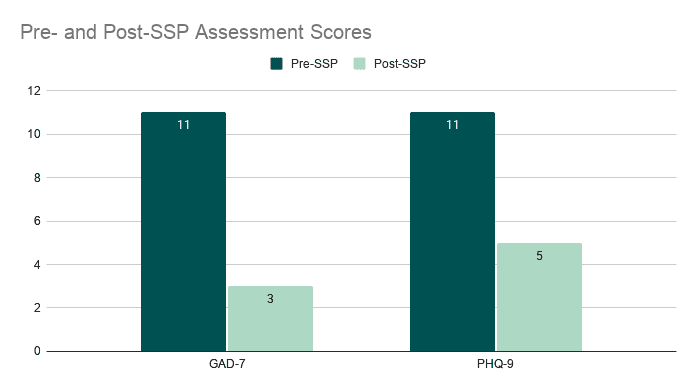
John initially reported moderate anxiety and moderate depression, as evidenced by baseline scores of 11 on both the Generalized Anxiety Disorder (GAD-7) and Patient Health Questionnaire (PHQ-9) assessments. He described feeling “lost in life,” stuck and in need of significant change.
At the time of the delivery of the Safe and Sound Protocol (SSP), he was living in New Zealand and working short-term jobs. Notably, John had been participating in psychotherapy for 11 years, and his psychotherapist referred him to SSP provider, Vincent Wilkin, specifically to address this ongoing impasse.
Implementation of the Safe and Sound Protocol (SSP)
The SSP was delivered remotely. Each clinical session lasted approximately one hour and followed a structured, co-regulatory framework. Sessions began with 10 minutes of talking and clinical debriefing, followed by 15 minutes of somatic exercises. SSP was then integrated for 20 to 30 minutes, and each session concluded with a five-minute debrief.
John completed all five hours of both SSP Core and SSP Balance. His provider, Vincent, instructed him to practice the taught somatic exercises for 15 minutes independently every day and to maintain a personal journal.
Response
Following the SSP, John’s clinical assessment scores demonstrated dramatic improvement. His GAD-7 score dropped from 11 to 3, and his PHQ-9 score decreased from 11 to 5.
A shift also occurred in relation to his alcohol consumption. During his progress through SSP Balance, John stopped drinking alcohol entirely. While he had not previously disclosed his alcohol consumption, he revealed during the final appointment that he had been engaging in heavy social drinking every time he went out, frequently resulting in two-day hangovers.
This underlying alcohol consumption shed light on his clinical presentations during the first half of the SSP, during which Vincent experienced difficulty with treatment compliance and punctuality. John frequently missed appointments entirely or arrived several hours early or late.
Ultimately, John reported feeling more grounded and expressed happiness about having stopped drinking completely. He shared that he now feels he has his life in his hands and is beginning professional dive training, a longtime dream he previously lacked the agency to pursue. He reflected that this was the first time in his history of therapy that he could see concrete, real-world results that impacted his daily life so profoundly. Furthermore, his referring psychotherapist expressed satisfaction with the transformative changes the SSP facilitated.
Discussion
Vincent reflected that he was quite amazed by John’s change, noting that John had steered his life in the right direction in only a few months.
While the initial stages of the program revealed challenges with attendance and punctuality, Vincent recognized that John was struggling and felt lost in life. He chose to remain a steady, supportive presence and reflected that this patience was important in helping John stabilize and eventually move toward meaningful change.


 © 2026 Unyte Health US Inc.