
The information presented in this case study was submitted by the identified provider and reviewed by the Unyte Clinical Team. Modifications to the text have been made solely for the purpose of enhancing comprehension and clarity for the reader’s benefit, and were carefully applied while ensuring the accuracy and integrity of the original submission. Unyte Health makes every effort to use updated terms and inclusive language, this case study retains the author’s original descriptions to be most sensitive to the client’s identity and preferences.
About the Provider
Name: Stacey Christensen
Organization Name: Cook Counseling and Consulting Inc
Disciplines/credentials: LISW-S, LCSW
Modalities: Safe and Sound Protocol (SSP)
Client Background
Name: Janine (pseudonym)
Age and Gender: 45-year-old woman
Program Delivered: Safe and Sound Protocol (SSP) Core (Hours 1-5), Balance (Hours 1-2)
When Janine met with provider Stacey Christensen, she presented with severe symptoms across multiple domains:
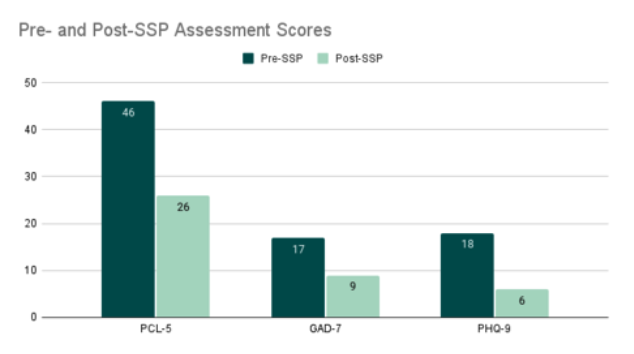
- Severe anxiety: GAD-7 score of 17
- Clinical PTSD: PCL-5 score of 46
- Moderately severe depression: PHQ-9 score of 18
Janine reported that these symptoms made it extremely difficult for her to function in daily life, impacting her capacity for emotional regulation, stability and well-being. Stacey suggested that Janine integrate the SSP into her ongoing psychotherapy, which included DBT, CBT and mindfulness.
Implementation of the Safe and Sound Protocol (SSP)
Janine began listening to the SSP in person with Stacey so that they could integrate co-regulation techniques into the listening sessions. Once Janine felt comfortable, she began listening at home, monitoring her progress through journaling. She continued pairing regulating activities, such as deep breathing and coloring, during her home listening. Janine completed routine five- to 10-minute structured sessions for six months.
Response
Janine demonstrated immense progress both qualitatively and quantitatively. On all three diagnostic tests mentioned above, Janine moved from clinical severity levels to mild or subclinical levels, indicating strong improvement. The test results break down as follows:
- Anxiety (GAD-7): Score decreased by 8 points, exceeding the minimal clinically significant difference.
- Depression (PHQ-9): Score decreased by 12 points, indicating a substantial improvement in mood, energy and motivation.
- PTSD (PCL-5): Score decreased by 20 points, shifting symptoms from the clinical threshold to subclinical.
In her daily life, Janine’s internal regulatory ability increased. She became aware of when she was experiencing overwhelm much faster and used tools like breathwork to interrupt escalation. Additionally, she noted improvements in communication with family members and a strengthened ability to set firm boundaries.
When reflecting on her experience, Janine said, “The SSP, along with talk therapy, has helped me untangle my insides, which I didn’t even know was possible. I’ve learned to slow down my thoughts and calm myself.”
Discussion
For clients experiencing a diverse range of symptoms like Janine, the SSP offers profound therapeutic potential as an adjunctive intervention. By directly targeting the autonomic nervous system to create a neurophysiological foundation of safety, the SSP supported the efficacy of traditional psychotherapy.