
Rest and Restore Protocol™: A Listening Therapy Designed for Restoration

Enhanced Conditions for Autonomic Support
Provides a structured, therapist-guided listening environment over ten sessions that aims to support the conditions for autonomic comfort and steadiness, helping clients participate in daily life with greater ease.

Supports Rest, Settling, and Digestive Comfort
Helps create a calmer internal state that may be associated with patterns of rest, digestive comfort, and an overall sense of balance.

Encourages Emotional Awareness & Stress Coping Capacity
Facilitates a listening experience in which clients may become more aware of emotions and better able to navigate stress with calm and clarity.

Promotes a Sense of Calm & Steadiness
Provides a gradual, titrated pathway that supports clients in moving from a state of tension or fatigue toward a more relaxed and grounded experience over the course.

Integrates Seamlessly with
Restorative Care
Restorative Care
Designed to complement body-based therapies, mental-health approaches, functional-health modalities, and neurodevelopmental frameworks by offering supportive sonic conditions that align with autonomic-focused care.

Supports Clarity, Focus & Creative Engagement
As clients move through the program, they report a greater sense of clarity, focus, or creative engagement, responses often associated with familiar rhythmic experiences that feel predictable and soothing.
When Rest and Regulation Are Hard to Access
Clients and practitioners alike can feel the impact across sleep, energy, emotional balance, and engagement in care.
Who Rest and Restore Protocol™ May Support
Many clients experience underlying physiological challenges that interfere with their ability to restore and regulate:
Chronic Stress & Fatigue
Persistent exhaustion or low energy despite rest.
Sleep Challenges
Difficulty falling asleep, staying asleep, or waking rested.
GI & Gut-Related Issues
Discomfort, irregularity, or tension connected to stress.
Emotional Imbalance & Anxiety
Overwhelm, heightened vigilance, or difficulty finding calm.
Practitioner Impact
Many providers encounter clients who struggle to engage fully in care due to disrupted physiological rhythms:
Stalled Sessions
Clients arrive depleted or dysregulated, making deeper therapeutic work difficult to access.
Limited Capacity to Engage
Stress or shutdown states reduce a client’s ability to participate or integrate.
Slow Progress
Disrupted rhythms (sleep, digestion, energy) limit therapeutic momentum.
Burnout & Friction
High clinician effort with fewer results; harder rapport when clients are in fight/flight/freeze states.
Grounded in neuroscience and developed by Anthony Gorry and Dr. Stephen Porges, Rest and Restore Protocol (RRP) supports restoration, recovery, and homeostasis by engaging autonomic regulation, internal rhythmic coherence, and subdiaphragmatic processes that contribute to balance and self-regulation.
The Science Behind Rest and Restore Protocol: Grounded in Behavioral Neuroscience
Developed by Anthony Gorry and Dr. Stephen Porges, Rest and Restore Protocol™ is informed by decades of research in autonomic regulation, rhythmic entrainment, and sound-based approaches.
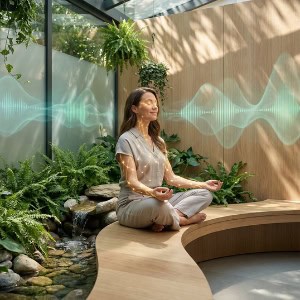
Rhythmic Entrainment & Autonomic Regulation
Using composition-constrained, rhythmically embedded soundscapes grounded in homeostatic entrainment within a behavioral neuroscience framework, this approach offers a steady, supportive auditory experience that encourages calm, settling, and overall well-being.

Targets Homeostasis
This approach uses structured, rhythmically informed soundscapes to help create conditions that feel steady, grounded, and supportive. These listening environments are designed to encourage a sense of internal balance and ease, without acting on specific physiological systems.

Deep Parasympathetic Restoration
The protocol offers calming auditory cues that can help listeners settle and unwind. This may support a shift toward a more relaxed state and create space for reflection, comfort, and gentle decompression.

Restorative Stillness & Physiological Settling
Many listeners describe experiencing a deep sense of quiet and stillness during sessions. This calm, settled state can complement other wellbeing or therapeutic practices by helping people feel more present and receptive.
“Rest and Restore Protocol feels like the icing on the regulation cake. It’s so easy, it flows, and my clients just continue to feel better and safer with each session.”
Terri Rowland, Therapist
Rhythm for Restoration
Music Inside Rest and Restore Protocol™
Music Inside Rest and Restore Protocol™
Purpose-Composed Algorithmic Music
Each composition is uniquely created through proprietary IP specifically for this protocol and is not adapted from generic, commercial, or library tracks.
Not Generic or Commercial Music
This is not a standard “relaxation playlist”, library music, or filtered commercial tracks. Its development is informed by more than five decades of research in behavioral neuroscience and sound-based approaches.
Supportive, Not Standalone
Rest and Restore Protocol™ is intended as a supportive, provider-directed listening resource. It is designed to be used within a broader therapeutic or wellbeing context and is not a personalised, diagnostic, or standalone medical or psychological treatment.
Quantifiable Impact: Early Pilot Results
93%
Of participants reported an improvement in anxiety symptoms.
67% moved from a clinical level to a non-clinical level (score <10).
Pilot group: 27 clients reported significant symptoms on the GAD-7 before starting RRP.
76%
Of participants reported an improvement in insomnia symptoms.
44% moved from a clinical level to a non-clinical level (score <6).
Pilot group: 68 clients reported significant symptoms on the AIS before starting RRP.
82%
Of participants reported an improvement in depression symptoms.
68% moved from a clinical level to a non-clinical level (score <10).
Pilot group: 22 clients reported significant symptoms on the PHQ-9 before starting RRP.
88%
Of participants reported an improvement in trauma symptoms.
72% moved from a clinical level to a non-clinical level (score <30).
Pilot group: 25 clients reported significant trauma-related symptoms on the PCL-5 before starting RRP.
Results are compiled following completion of at least one hour of RRP.
Rest and Restore Protocol Experience
Every Rest and Restore Protocol journey is guided by a trained professional, like yourself.

Get trained in Rest and Restore Protocol
Learn about Rest and Restore Protocol™, including nervous system regulation foundations and practical client delivery, through on-demand training. Training equips providers to implement RRP safely and effectively in their practice.

Activate Your Subscription
Your active Rest and Restore Protocol subscription enables you to deliver the protocol. It includes the Unyte Health app for client listening, MyUnyte for managing programs, assessments, resources, and community support.

Deliver Rest and Restore Protocol
Rest and Restore Protocol™ is a titrated, 10-session listening course designed to gradually increase a client’s physiological accessibility over time. By supporting autonomic stability in a stepped, controlled way, the protocol helps clients become more regulated, receptive, and therapeutically available across the full duration of treatment.

Access Ongoing Support
Get Rest and Restore Protocol-specific resources, clinical assessments, tools, and a community of peers and mentors to support client work and professional growth. Guidance is available for implementing RRP alongside broader therapeutic or wellbeing care.
Experience the benefits of Rest and Restore Protocol in your practice.
What Providers Are Saying
“Rest and Restore Protocol feels like the icing on the regulation cake. It’s so easy, it flows, and my clients just continue to feel better and safer with each session.”
— Terri Rowland, Therapist
“For some clients, RRP helps build the capacity to be with somatic discomfort — to stay present, embodied, and find safety even when the body is processing big things.”
— Shelly Melroe, LMFT
“Rest and Restore Protocol supports releasing defensive states, fostering relaxation and restoration. By deepening trust, it opens access to new portals that enhance and expand regulatory capacity.”
— Tracy Stackhouse, OTR
Case Studies

Regaining Strength After COVID-19
Jake, aged six, suffered lasting COVID-19 complications. Integrating Rest and Restore Protocol with physiotherapy led to marked gains in cardiovascular strength, balance, and muscle tone. He also became more confident, regulated, and able to enjoy noisy environments, restoring his independence and quality of life.

Restoring Sleep and Calm
Ryan, an 11-year-old adoptee with attachment trauma, struggled with severe sleep disruption and emotional dysregulation. After starting Rest and Restore Protocol, his sleep improved from 4 to 9-10 hours nightly, becoming deeper and more restful. Better sleep boosted emotional regulation, receptivity to change, and energy, allowing his playful, confident personality to emerge.

Relief from Stress and Tension
AS, experiencing stress-triggered heart palpitations, found instant relief with Rest and Restore Protocol. Her autonomic stress response significantly dropped, showcasing Rest and Restore Protocol’s power to reduce physical tension and enhance well-being.
We invite you to join our community of Certified Providers Cultivating Rest and Restoration!
You must be a qualified professional to deliver Unyte listening therapies. Training and Certification covers both theory and the practical application of the Rest and Restore Protocol. Once certified, a subscription is required to deliver the Rest and Restore Protocol to your clients.
Have questions? We’re here to guide you!
Book a free, personalized consultation or call us directly at 1-866-594-9453.

 © 2026 Unyte Health US Inc.