
The information presented in this case study was submitted by the identified provider and reviewed by the Unyte Clinical Team. Modifications to the text have been made solely for the purpose of enhancing comprehension and clarity for the reader’s benefit, and were carefully applied while ensuring the accuracy and integrity of the original submission. Unyte Health makes every effort to use updated terms and inclusive language, this case study retains the author’s original descriptions to be most sensitive to the client’s identity and preferences.
About the Provider
Name: Kristina Knabenshue
Disciplines/credentials: LCPC
Modalities: Safe and Sound Protocol (SSP), CBT, ADHD-CCSP, ASDCS, MI, SF
Client Background
Name: AJ (pseudonym)
Gender and Age: Woman, 45 years old
Program Delivered: Safe and Sound Protocol (SSP)
- SSP Connect: Hour 1
- SSP Core: Hours 1-5 (two rounds)
- SSP Balance: Hour 1 (briefly incorporated)
The client, AJ, a 45-year-old woman, presented with a primary diagnosis of post-traumatic stress disorder (PTSD), secondary bipolar disorder, and longstanding difficulties with interpersonal functioning, anxiety, irritability, and depression. These issues significantly impacted her relationships, trust in others, personal decision-making, impulse control, and occupational functioning. Her daily life continued to be influenced by trauma-related responses, impeding her ability to experience a sense of safety.
AJ has a significant trauma history spanning from childhood through adulthood, with ongoing effects on her daily functioning and relationships. She had previously engaged in outpatient therapy and benefited from supportive individuals who assisted with co-regulation. She specifically sought the SSP to explore whether additional nervous system support could improve her overall quality of life.
Her primary goals for engaging with SSP included improving interpersonal functioning, reducing anxiety, irritability, and depression, and increasing her sense of safety in daily life. The SSP was considered appropriate given her persistent sensitivity to perceived threats and the availability of supportive relationships for co-regulation.
Implementation of the Safe and Sound Protocol (SSP)
SSP intervention began with an in-person session, which included practicing co-regulating activities before transitioning to remote delivery with frequent check-ins. The client completed two rounds of SSP Core: the first from late January through late February 2026, and the second from late April through early July 2026.
Prior to starting SSP Core, AJ participated in SSP Connect to help identify a suitable playlist. Brief periods of SSP Balance were incorporated around both rounds of SSP Core, although neither SSP Balance program was fully completed.
The therapeutic approach focused exclusively on the SSP, supplemented by psychoeducation and practical nervous system regulation resources. No additional psychotherapy modalities were integrated. The intervention emphasized understanding trauma-related patterns of activation, increasing awareness of perceived safety, and identifying opportunities for both co-regulation and self-regulation.
Throughout the process, ongoing check-ins provided opportunities to discuss symptoms, monitor the client’s experience, and adjust listening as needed. The pace remained flexible and responsive to AJ’s circumstances; listening was paused or modified during periods of heightened stress or sudden changes in routine to prevent overwhelm.
AJ received multiple Unyte handouts, resources explaining polyvagal concepts, and techniques to support nervous system regulation. These materials helped contextualize her longstanding experiences of anxiety, irritability, and difficulty feeling safe in relationships. Education emphasized the connection between perceived safety, physiological activation, emotional responses, and interpersonal functioning. Supportive individuals were available to assist with co-regulation, and AJ was introduced to practical strategies intended to strengthen awareness of nervous system states and support regulation in daily life.
Response
Following the first round of SSP Core, AJ reported significant improvements in her emotional regulation and interpersonal functioning. She described:
“After the first SSP treatment, I found that I did not have as much anxiety. It took me a little longer to get worked up, and I, for the most part, could calm myself a little more quickly depending on the situation. I found that certain people’s voices that used to be a trigger were no longer triggers, and I was able to be around them for longer periods of time without feeling like I was going to explode. I had more patience with my son, less conflict overall, and the conflict I did have was not nearly as explosive.”
— AJ (pseudonym)
This testimony highlighted meaningful changes in her daily life, emotional regulation, and relationships, which were also noticed by her son and her brother.
During the second round of SSP Core, AJ reported additional progress, including encountering individuals associated with past traumatic experiences without experiencing PTSD symptoms. She also noted an improved ability to relax more quickly and reported better sleep.
Assessment results, administered prior to the first round of SSP Core (January 2026) and after the completion of the second round (July 2026), demonstrated marked reductions in symptoms:
- GAD-7 (Generalized Anxiety Disorder 7-item scale) decreased from 7 to 4.
- PHQ-9 (Patient Health Questionnaire 9-item scale) decreased from 13 to 3.
- AIS (Athens Insomnia Scale) decreased from 8 to 5.
- PCL-5 (PTSD Checklist for DSM-5) decreased from 41 to 13.
- NPSS (Neuroception of Psychological Safety Scale) increased from 82 to 103.
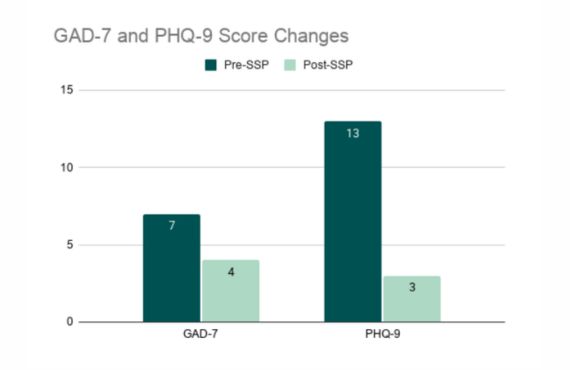
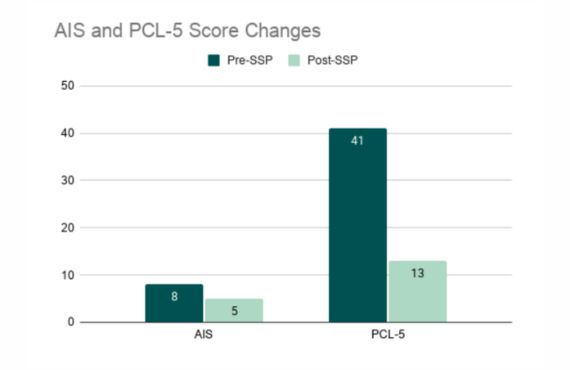
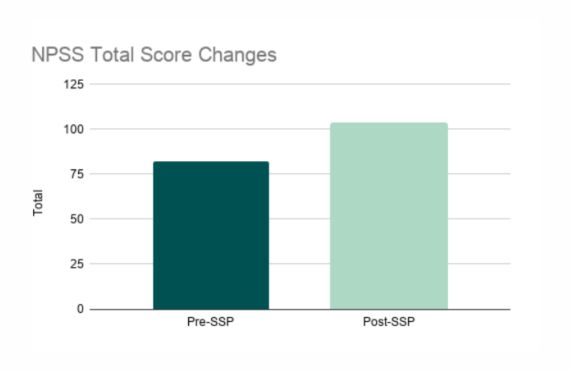
These scores reflect significant reductions in anxiety, depression, sleep difficulties, and trauma-related symptoms, alongside an increased sense of psychological safety. Most notably, the PTSD and depression scores were reported as moving from clinical levels to non-clinical levels following SSP delivery. The follow-up assessments captured changes across the entire intervention period, indicating cumulative benefits.
Discussion
This case study underscores the significant potential of the Safe and Sound Protocol in supporting complex trauma recovery, particularly for individuals struggling with long-standing interpersonal and emotional regulation difficulties. The marked improvements in assessment scores demonstrate how nervous system regulation can foster a greater sense of safety, reduce physiological activation, and enhance overall quality of life.
The provider, Kristina Knabenshue, reflected that incorporating more in-person sessions in future cases could further amplify opportunities for co-regulation, which is vital for clients learning to recognize and respond to shifts in their nervous system state. While remote delivery offers accessibility, in-person interaction provides unique opportunities for modeling regulating activities and noticing somatic responses. Kristina also noted the challenge of encouraging client participation in SSP but remains committed to integrating Polyvagal Theory and nervous system regulation in practice.


 © 2026 Unyte Health US Inc.