
The information presented in this case study was submitted by the identified provider and reviewed by the Unyte Clinical Team. Modifications to the text have been made solely for the purpose of enhancing comprehension and clarity for the reader’s benefit, and were carefully applied while ensuring the accuracy and integrity of the original submission. Unyte Health makes every effort to use updated terms and inclusive language, this case study retains the author’s original descriptions to be most sensitive to the client’s identity and preferences.
About the Provider
Name: Dana K. Boggia
Organization Name: St. Clair County Child Abuse and Neglect Council
Disciplines/credentials: LPC, NBCC
Modalities: TF-CBT, EMDR, play therapy, CBT, PSB, Safe and Sound Protocol (SSP)
Client Background
Name: Lee (pseudonym)
Age and Gender: Girl, 12 years old
Program Delivered:
- Safe and Sound Protocol (SSP)
- SSP Core: Hours 1-5
Lee is a 12-year-old girl living in a rural community with her lower-income family consisting of her maternal grandmother, her mother, her father, and a 15-year-old maternal half-brother. Another 15-year-old paternal half-brother was removed from the home due to perpetrating 1.5 years of sexual abuse against Lee. The parents’ marriage is reported to be fractured with increased tension in the home, and the family finds it difficult to share feelings or discuss the trauma Lee experienced.
Lee presented with a diagnosis of post-traumatic stress disorder (PTSD) accompanied by an Adverse Childhood Experiences (ACE) score of 2. Prior to the intervention, her Child PTSD Symptom Scale (CPSS) score was 36, indicating severe PTSD. Her symptoms included frequent nightmares, which left her too fearful to sleep alone in her room, forcing her to sleep with her mother. She also experienced eating issues, panic attacks, a pervasive fear of being alone, and profound feelings of hopelessness and helplessness.
The family requested therapy to address the trauma following a forensic interview. The primary therapeutic goals were to provide psychoeducation regarding the brain, body and trauma responses; reduce anxiety and the frequency of nightmares; establish a baseline of safety allowing Lee to sleep independently at night; develop effective coping strategies; and help her identify and label physiological sensations of emotion in her body.
Implementation of the Safe and Sound Protocol (SSP)
The Safe and Sound Protocol (SSP) was delivered entirely in person. Lee did not feel her body was able or ready to handle the processing of her trauma and needed ways to reduce her active fight-or-flight responses. Her provider, Dana K. Boggia, chose to use SSP to help expand Lee’s window of tolerance and capacity to remain present and connected during therapy.
The implementation was heavily tailored to support Lee’s sensory and co-regulation needs. She preferred a low-light environment, lying on a yoga mat under a weighted blanket for heavy proprioceptive input. An essential oil diffuser was used to engage the olfactory system in a calming manner. The practitioner lay on a nearby yoga mat and co-regulated with Lee through structured breathwork and gentle somatic body movements, including hip stretches, legs-up-the-wall positioning, and progressive muscle relaxation.
Lee successfully tolerated 30-minute sessions conducted once per week. The Classical Flow playlist was used for the first two hours. At Hour 3, Lee requested a transition to the Groove (Instrumental) playlist, which was maintained through Hours 4 and 5. Alongside the auditory intervention, Dana provided psychoeducation on the autonomic nervous system and integrated Eye Movement Desensitization and Reprocessing (EMDR) alongside SSP sessions to solidify Lee’s sense of security and control.
Response
Following the completion of the five-hour SSP Core pathway, Lee self-reported an enhanced sense of calmness and a significantly reduced physiological threat response. Remarkable shifts were observed in her sleeping patterns and daily functioning:
- Sleep and Nightmares: Lee successfully transitioned to sleeping in her own bedroom by herself with the door closed. Her nightmares decreased from a baseline of two to three times per week down to just one occurrence over a four-week period.
- School Functioning and Anxiety: Lee reported a notable reduction in school-based anxiety and did not call her mother to leave school early for three consecutive weeks.
- Somatic and Emotional Shifts: She experienced reduced nausea, resulting in improved food intake. Furthermore, her pervasive feelings of hopelessness and helplessness subsided.
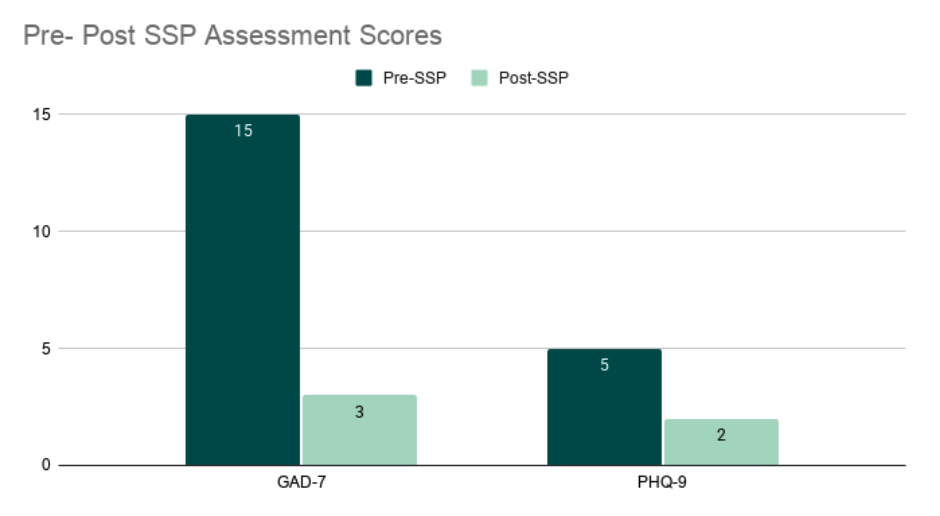
The clinical shifts were strongly reflected in Lee’s pre- and post-intervention standardized assessments:
| Assessment | Pre-SSP Score | Post-SSP Score | Clinical Interpretation |
|---|---|---|---|
| CPSS (Child PTSD Symptom Scale)* | 36 | 21 | Shifted from Severe to Mild PTSD |
| GAD-7 (Generalized Anxiety Disorder)** | 15 (Severe) | 3 (Minimal) | Significant reduction in clinical anxiety |
| PHQ-9 (Patient Health Questionnaire)** | 5 (Mild) | 2 (Minimal) | Reduction in depressive symptomatology |
*Administered four weeks pre-SSP and three weeks post-SSP.
**Administered one week pre-SSP and one week post-SSP.
Lee’s mother reported a very high regard for the intervention, noting profound positive changes in her daughter. Approximately 11 weeks post-completion, Lee experienced a temporary spike in anxiety and sleep difficulties due to her parents discussing a divorce. She requested a “booster” session of the SSP. Upon returning the following week, she reported that her sense of calm had returned, her anxiety had decreased, and her sleep was steadily improving again.
Discussion
“I appreciated this intervention because the client was not ready or able to discuss her trauma,” Dana shared. “She was avoiding at all costs and did not trust her body could yet handle the memories she is so careful to ‘lock away.’ This intervention allowed the body to reset, to reduce her fight-or-flight responses, and taught her she can have some control over her body’s responses to the trauma.”
Integrating somatic movement, intentional breathwork, and a highly controlled sensory environment allowed Lee to feel fully in control of her body and her physiological responses. The deep co-regulation established by Dana lying nearby on a yoga mat created the relational safety necessary for Lee’s nervous system to accept the auditory input.
Ultimately, the SSP successfully helped Dana and Lee establish the internal stabilization and physiological resilience that traditional talk therapies could not safely access at the start of treatment.


 © 2026 Unyte Health US Inc.